
Alternatives – Barrier Reverse Convertible or Low Strike?
Investors in Swiss francs currently face the challenge of achieving attractive returns with bonds. While currencies like the US dollar offer higher interest rates, interest rates in Switzerland remain low, and bonds often yield only 1–2%. For these investors, structured products such as Barrier Reverse Convertibles (BRCs) and Low Strike products provide attractive alternatives to generate higher returns.
How does a Barrier Reverse Convertible (BRC) or Low Strike work?
A Barrier Reverse Convertible (BRC) is a structured financial product based on a basket of underlying assets such as stocks, indices, commodities, or currencies. The investor receives regular coupon payments regardless of the performance of the underlying assets. However, the central risk lies in the so-called barrier, which is typically set well below the current prices of the underlying assets.
If the barrier is breached during the term by any of the underlying assets (e.g., a stock or index), there are consequences: at maturity, the investor will be repaid in the worst-performing underlying asset (or in cash equivalent). If that asset has lost significant value, this may result in substantial losses.
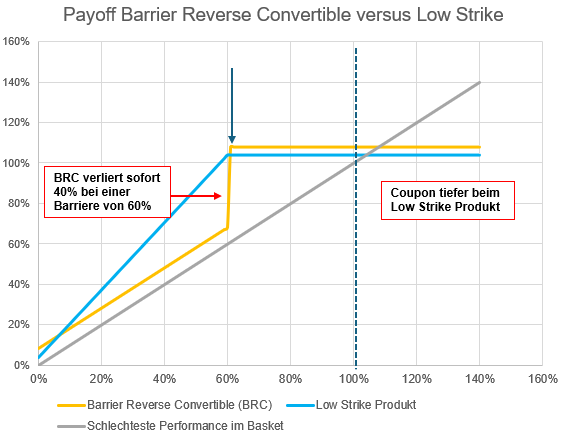
In a Low Strike product, there is no barrier, only a so-called strike price. If the price of the "worst performer" falls below this strike price, the investor’s loss corresponds to the difference between the asset’s price and the strike price. Unlike a BRC, however, there is no sudden drop into the loss zone when prices fall—the risk increases gradually, without a sudden trigger like the barrier breach in a BRC.
Main Difference: Risk Profile and Barriers
Barrier Reverse Convertibles (BRCs) offer significantly higher coupons compared to Low Strike products. This is the main reason why most structured products on the market are BRCs. The focus is clearly on the high coupon, often overlooking the potential risks. However, these higher returns come with substantially higher risk. Once a barrier is breached in a BRC, the resulting loss can be significant. For instance, a strike at 60% could result in a 40% loss, as shown in the graphic. These losses occur abruptly if the underlying asset drops below the barrier.
In contrast, Low Strike products are characterized by a more stable risk profile. Even if the underlying asset falls sharply, the risk of a sudden loss is limited. If the strike is breached, losses increase gradually, not abruptly. There is no sudden threshold like in a BRC, making these products more attractive to risk-conscious investors.
Low Strike as a Bond Replacement
For investors in Swiss francs, Low Strike products can be an attractive alternative to traditional bonds. While bonds currently yield only 1–2%, defensive Low Strike products can deliver returns of up to 3–4%. We consider products with a low strike of 50–60% and carefully selected stocks as underlying assets to be defensive. This is why we use these products for clients seeking regular income. They offer a stable source of returns with manageable risk and are therefore well suited as bond replacements.
In summary, Barrier Reverse Convertibles offer tempting yields due to their high coupons, but they carry significantly higher risk. Defensive Low Strike products, on the other hand, offer a balanced approach—lower coupons (still higher than bonds) with reduced risk—making them particularly suitable for clients looking for regular income with calculated risk.
How to invest?
📈 If you’re interested in an investment strategy that also aims to generate income, we’d be happy to show you the options available within our asset management offering.


